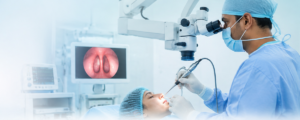
Endoscopic ENT surgery has changed significantly over the last few decades. Procedures that once required larger external incisions can now, in many cases, be performed through natural openings using an endoscope, camera systems and specialised instruments. This has made several E.N.T. procedures more precise and less invasive.
But does endoscopic ENT surgery completely replace open ENT surgery? No. The right approach depends on the condition being treated, its location, severity, anatomy, previous surgeries and the surgeon’s assessment.
Endoscopic ENT surgery is particularly important in conditions involving the nose and sinuses. In selected patients, an endoscope allows the surgeon to access affected areas through the nasal passages without making an external facial incision. Modern imaging and surgical technology have further improved planning and visualisation.
Understanding the difference between endoscopic and open surgery can help patients have a more informed conversation with their ENT surgeon.
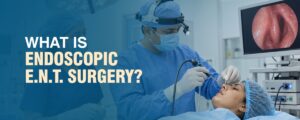
What Is Endoscopic E.N.T. Surgery?
Endoscopic ENT surgery uses a thin instrument called an endoscope. It contains a light and camera that allow the surgeon to see structures inside the nose, sinuses, and other areas of the E.N.T. system.
Instead of creating a large external opening, the surgeon may access the affected area through a natural body opening, depending on the procedure.
One of the best-known examples is endoscopic sinus surgery. During this procedure, the surgeon uses an endoscope to identify and treat disease within the nasal and sinus passages.
The objective is not simply to make surgery “smaller.” The goal is to treat the underlying problem while preserving healthy structures whenever possible.
How Is Open E.N.T. Surgery Different?
Open ENT surgery involves creating an external incision or a larger surgical access route to reach the affected structure.
Open approaches may still be necessary or preferable in certain situations. Examples can include extensive disease, selected tumors, complicated anatomy, trauma, revision surgery or conditions where endoscopic access does not provide adequate exposure.
Therefore, calling open surgery “old-fashioned” would be misleading. Modern ENT surgery is not about choosing the newest technique automatically. It is about choosing the most appropriate technique for the patient’s specific condition.
Which E.N.T. Procedures Have Become More Endoscopic?
1. Sinus Surgery
Sinus surgery is one of the clearest examples of the evolution toward endoscopic techniques.
Endoscopic sinus surgery can provide access to the sinus drainage pathways without an external facial incision. The procedure may help restore drainage and ventilation while allowing diseased tissue to be treated.
Current clinical guidance emphasises confirming the diagnosis, evaluating symptoms and quality of life, considering previous medical treatment and using appropriate CT imaging for surgical planning in patients who are candidates for surgery.
2. Nasal and Skull Base Procedures
Advances in endoscopic equipment have also expanded the role of endoscopic approaches in selected nasal and skull base procedures.
These operations require specialised expertise because the anatomy can be extremely delicate and lies close to important structures such as the eyes, optic nerves, blood vessels and brain.
3. Ear Procedures
Endoscopic techniques are also being used in selected ear surgery procedures. An endoscope can provide visualisation of areas that may be difficult to see through a conventional microscopic view.
However, endoscopic ear surgery does not mean every ear condition can or should be treated endoscopically. The choice depends on the disease and anatomy.
What Are the Advantages of Minimally Invasive E.N.T. Surgery?
When appropriate for the condition, minimally invasive ENT surgery may offer several advantages.
Smaller or No External Incision
Because access may be through a natural opening, certain procedures can avoid an external incision.
Better Visualization
A high-definition camera can provide magnified views of small anatomical structures. This can help the surgeon identify disease and navigate complex areas.
Tissue Preservation
Modern minimally invasive ENT surgery techniques often aim to remove or treat diseased tissue while preserving healthy structures.
Potentially Easier Recovery
Depending on the operation, avoiding a large external incision can reduce certain aspects of postoperative recovery.
However, patients should not assume that every endoscopic surgery automatically means a quick or painless recovery. Recovery varies according to the procedure and individual patient.
Does Endoscopic Surgery Mean There Are No Risks?
No.
Every surgical procedure has potential risks. ENT surgery may involve bleeding, infection, scarring, recurrence of disease, changes in symptoms or other procedure-specific complications.
For sinus surgery in particular, the sinuses are located close to the eyes and the skull base. This makes careful preoperative assessment and surgical planning extremely important. Clinical guidance recommends appropriate CT imaging for surgical candidates and emphasises postoperative monitoring and follow-up.
The surgeon should explain the expected benefits, limitations and possible complications before surgery.
When Might Open Surgery Still Be Recommended?
Open ENT surgery may remain appropriate when:
● Disease is extensive.
● The affected area cannot be adequately accessed endoscopically.
● There is significant structural involvement.
● A tumour requires a particular surgical approach.
● Previous surgery has altered the anatomy.
● Trauma requires wider access.
● Endoscopic surgery alone is unlikely to achieve the desired result.
The decision should be based on clinical findings and imaging rather than the assumption that one technique is always better.
Is Endoscopic Surgery Better Than Open Surgery?
There is no universal answer.
Endoscopic ENT surgery may be preferable when it can safely and effectively treat the disease with less disruption to surrounding tissues. Open ENT surgery may be necessary when wider exposure is required.
The important question is not “Which surgery is newer?” but “Which surgical approach is safest and most effective for my condition?”
What Should Patients Ask Their E.N.T. Surgeon?
Before surgery, ask:
● What exactly is my diagnosis?
● Why do I need surgery?
● Can my condition be treated without surgery?
● Is an endoscopic approach suitable for me?
● Why are you recommending this surgical technique?
● What are the expected benefits?
● What are the possible risks?
● What will recovery involve?
● Could the condition come back after surgery?
● Will I need long-term medication or follow-up?
These questions support shared decision-making and help patients understand what surgery can realistically achieve.
Frequently Asked Questions
Is endoscopic E.N.T. surgery minimally invasive?
Many endoscopic ENT surgery procedures are considered minimally invasive because they use natural openings or smaller access routes. However, the extent and invasiveness vary according to the procedure.
Is endoscopic sinus surgery painful?
Some discomfort, congestion and pressure can occur after endoscopic sinus surgery. Recovery differs between patients and procedures. Your ENT surgeon will provide individualised postoperative instructions.
Does endoscopic sinus surgery cure chronic sinusitis permanently?
Not necessarily. Endoscopic sinus surgery can improve sinus drainage and control disease in appropriately selected patients, but chronic rhinosinusitis can remain a long-term condition requiring medical management and follow-up.
Is open surgery outdated?
No. Open ENT surgery continues to have an important role in selected E.N.T. conditions where wider access is necessary.
How do I know which E.N.T. surgery is right for me?
An ENT surgeon should assess your symptoms, examination findings, imaging, medical history and the nature of the disease before recommending a surgical approach.
Conclusion
E.N.T. surgery has evolved considerably, particularly with the development of endoscopic visualisation, advanced imaging and specialised instruments. Endoscopic ENT surgery has transformed the management of many nasal and sinus conditions and has expanded into selected ear and skull base procedures.
However, minimally invasive does not mean universally appropriate. Open ENT surgery remains valuable for specific conditions.
If your E.N.T. specialist recommends surgery, focus on understanding why the procedure is required, what approach is appropriate, what outcome can realistically be expected and what postoperative care will involve.
At Dr. Rao’s ENT, patients can discuss their diagnosis, treatment options and surgical approach with an E.N.T. specialist before making a treatment decision.